Logic problems in Arminian theology often arise from assumptions about free will, responsibility, and grace that Scripture itself challenges.
By Roger Smalling
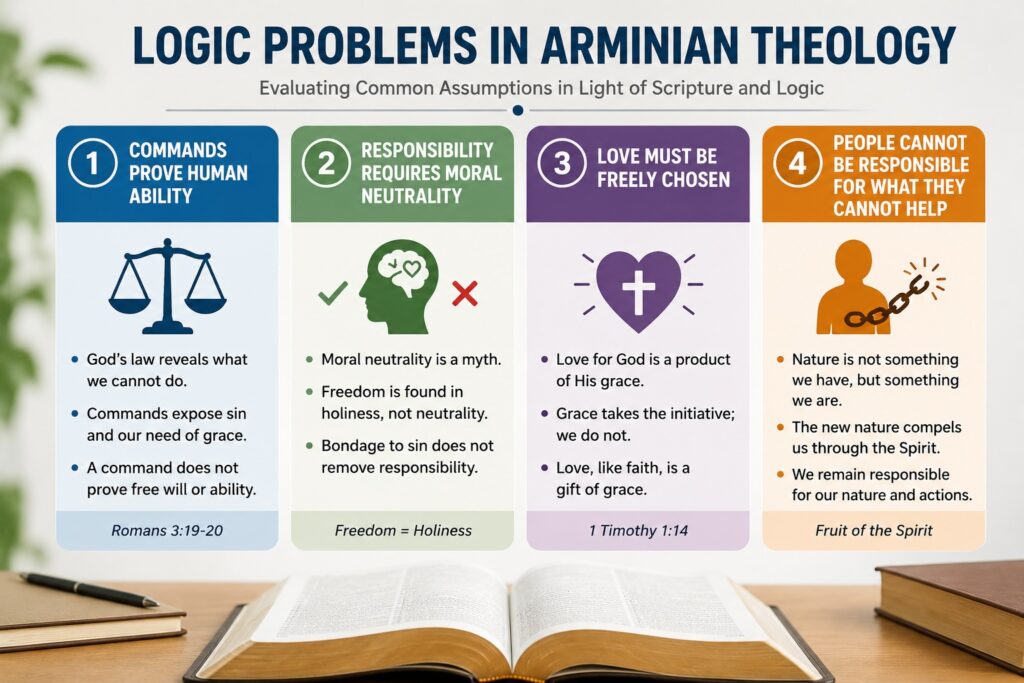
Fallacy One: Commands prove human ability
Why God’s law exposes inability
God gave the Law to Moses, the Ten Commandments, to reveal what man cannot do, not what he can do without God and without grace.
The Law of Moses exposes sin to increase it so man would have no excuse for claiming his own righteousness. Romans Chapter Three declares that man possesses no righteousness acceptable to God.
Martin Luther said to Erasmus, “When you are finished with all your commands and exhortations from the Old Testament, I’ll write Romans 3:19-20 over the top of it all.” (Luther, Bondage of the Will) Why refer to commands and exhortations from the Old Testament to prove free will when they were given to show man’s sinful inability to fulfill them?
God’s commands reveal what we cannot do rather than what we can do. Yes, God gave commands that mankind cannot obey. Therefore, commandments and exhortations do not prove man’s ability or free will. The Arminian assumption that a command proves the ability to do a thing is unscriptural.
There may be various reasons for commanding someone to do something. The purpose could be to show someone his inability to perform the command. This would underscore for that person his very need of help. From a mere command, therefore, nothing can be deduced about free will or human ability.
This example illustrates one of the central logic problems in Arminian theology: assuming that divine commands automatically imply human ability.
Fallacy Two: Responsibility requires moral neutrality
If not free, then not responsible
Arminians assume that our wills are only free if we are able to make a choice to the contrary. This argument is irrational because it assumes there is such a thing as moral neutrality.
The entire idea of the neutrality of will is absurd. If a person’s nature does not determine the decisions of the will, in what sense do such decisions represent the person himself? How could a decision be a truly moral one if it is morally neutral? Can morality be morality at all and still be neutral?
According to Scripture, freedom is described as holiness. The ultimate freedom is absolute holiness. If that is true, then God is the most free being in the universe. Otherwise, we must say God is the most enslaved being in the universe because he is the one least neutral on moral issues.
Likewise, if bondage of will eliminates responsibility, the best way to avoid responsibility for our sins is to be as bound by them as possible. The drunk, bound by alcoholism, is, therefore not responsible for his actions. Should we encourage people to sin more so they are no longer responsible?
Fallacy Three: Love must be fully chosen
For love to be real, it must have the possibility of being rejected
We often hear that God wants us to love him freely, not by compulsion. He is a gentleman that will not impose himself on anyone. They conclude that a fallen man must have the ability to love God. He simply chooses to love other things.
Scripture teaches love for God is a product of His grace. (1 Timothy 1:14) If grace is necessary to make us love God, it follows that we were unable to love him before grace came. It also indicates that grace is not given because we chose to love God. Grace takes the initiative. We chose to love God because grace is given, not because of a virtue or ability foreseen in man.
This premise is similar to fallacy one: God would command only what we can perform. Does God provide the saints in heaven an opportunity to hate him so as to be fair? Did Jesus have some ability to hate the Father? Or was His love for the Father a reflection of what He really is?
Since faith is a gift of grace, should it be strange to think that love must also be a gift of grace?
Fallacy Four: People cannot be responsible for what they cannot help
A person cannot be responsible or punished for what he cannot help
If such a situation is the case, a Christian may not be rewarded for what his new nature, through the fruit of the Spirit, compels him to do. The nature of a person is not something he possesses. It is something he is.
###
This article may be freely shared for ministry purposes.
For further study: See Unlocking Grace, a complete introduction to the Reformed doctrines of grace.
Related articles:
Does Foreknowledge Explain Election?
Free Will: Biblical vs Humanist View
Those who liked this article may enjoy our book,
Unlocking Grace